A note from the founder
The Indian Guitar Archives captures the life and journey of Indian guitarists, whether they are seasoned professionals or passionate beginners. As a neuroscientist and a guitar player myself, I feel deeply connected to the journeys of these artists.
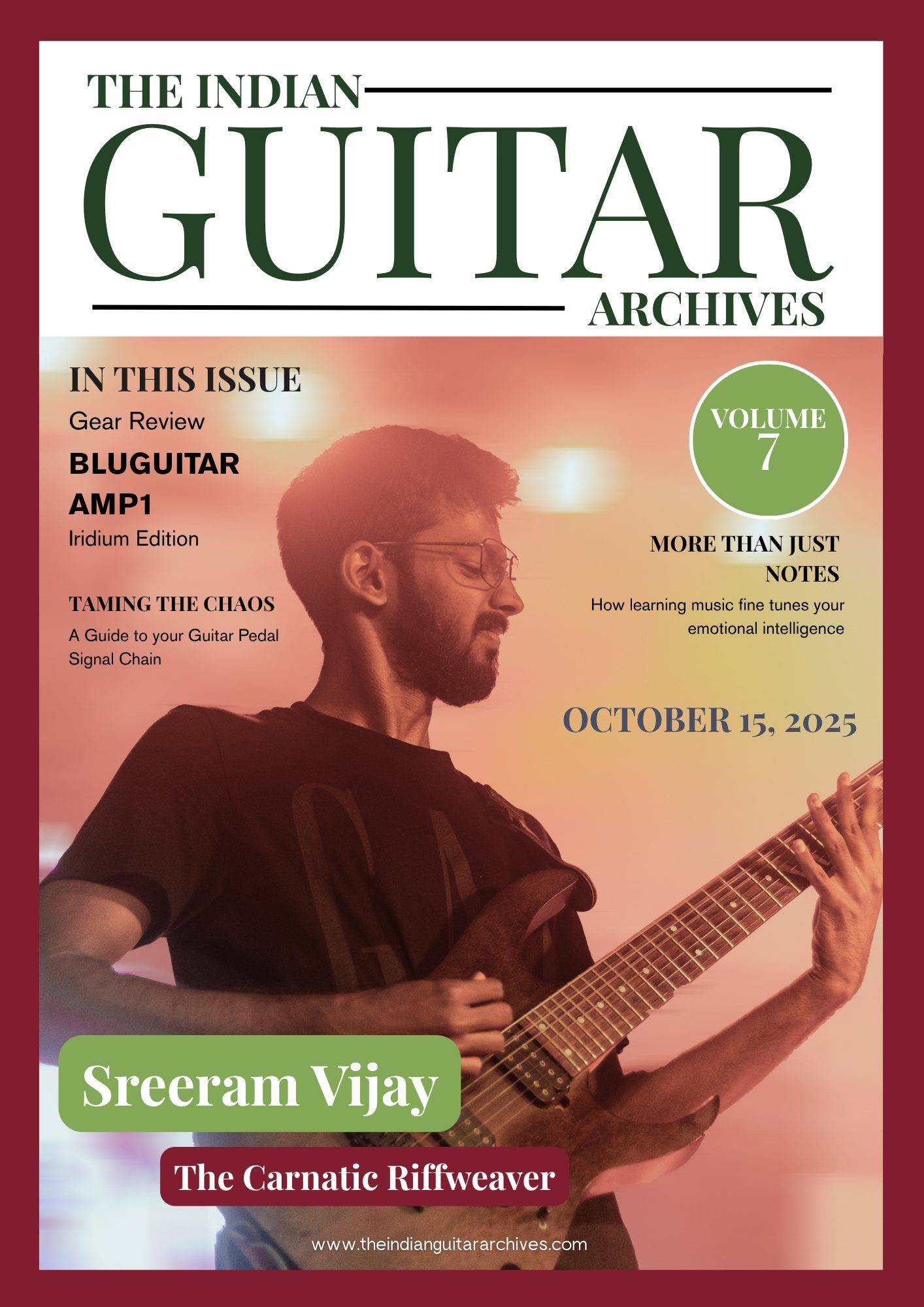
In this issue, we are proud to feature Sreeram Vijay, a guitarist whose roots in Carnatic music merge seamlessly with the raw energy of modern metal - a balance of tradition and innovation that captures the spirit of today's Indian guitar movement.
We also explore how learning music enhances emotional intelligence in "More Than Just Notes", take a deep dive into your pedalboard signal chain in "Taming the Chaos", and review the BluGuitar AMP1 Iridium, a powerhouse redefining portable amplification.
This issue arrives in a season of light, reflection, and renewal. As we celebrate Diwali, may your lives be filled with harmony, your hearts with rhythm, and your spirits with the same spark that ignites every note you play.
Sreeram Vijay
The Carnatic Riffweaver
View Full Profile →
When music first found its way into Sreeram Vijay's life, it was through the disciplined world of Carnatic training. For years, he immersed himself in ragas and rhythm under his guru. As adolescence brought its challenges, his guru suggested he rest his voice and channel his energy into an instrument - and a birthday gift from his father, a red burst acoustic guitar, sparked a journey that still continues.
A few months of basic lessons gave him a foundation, but the real learning came late at night, headphones in, with YouTube as both tutor and stage. Slash, Buckethead, and Led Zeppelin called to him first, and soon metalcore and progressive rock pulled him in deeper. Today his music carries the imprint of Carnatic discipline yet soars with the raw energy of rock and metal.
Early Musical Roots
My guitar journey started when I was in the 9th standard. My father bought me an acoustic guitar for my 14th birthday. My guru, Smt. Siva Janani, with whom I had been studying Carnatic music for almost half my life, insisted I take a break from singing and learn an instrument so I could give my vocal cords some rest. After a few months of basics with my instructor Vibin, academics meant I had to find time to learn on my own - that's when I turned to YouTube.
Discovering Inspiration
A school senior and close friend, Chikku - fondly nicknamed "Slash" - was the first person I ever saw play an electric guitar in front of me. Having grown up with Carnatic vocal training, the moment I saw that instrument roar through an amplifier, it felt like my soul momentarily left my body. The moment Sweet Child O' Mine hit my ears, I was obsessed.
Challenges Faced While Learning
In the beginning, I constantly had to correct myself - "You're holding the pick wrong," or "You're strumming in an unconventional way." But as I connected with my local community of musicians, I heard something reassuring: it's okay to find your own style as long as it works for you. There's no single perfect way to play the guitar.
First Guitar
My first guitar was a red burst cutaway acoustic from Crusader, a birthday gift from my father. It had a budget-friendly build, but the action turned out to be surprisingly good for its price. To whoever built my Crusader guitar, you've earned a permanent place in my heart.
Support System and Encouragement
Like many Indian families, mine believed nothing should come in the way of academics. Yet despite their reservations, my family supported me - from my first electric guitar to the seven-string Ibanez RG7421, a Line6 POD HD500X, an audio interface, and a decent PC to record covers. My friends were equally instrumental, taking me to concerts and even chipping in when gear needed fixing.
Musical Influences
My early influences were Guns N' Roses, Led Zeppelin, and Buckethead. As I grew, I was drawn to metalcore - ERRA, Novelists, and Our Last Night - for the complexity and melodic structure. I also can't leave out phenomenal Indian bands like Pineapple Express, Project Mishram, and Bloodywood, who represent the true spirit and diversity of the Indian music scene.
Visualizing Music While Composing
Melody usually comes to me before anything else, often before the lyrics or the tone. I think this instinct comes from my strong foundation in Carnatic music, especially its theories and jathis. My Carnatic roots still guide how I shape solos and phrasing.
Encouraging Emerging Guitarists
There are so many incredibly talented artists who remain underground, held back by finances, academic pressure, or life's responsibilities. We need more artist-centred community spaces and open, inclusive gig spaces that welcome walk-ins - invitations to be heard, to be seen, and to connect.
Advice for Aspiring Guitarists
Stay true to your style. Find a balance between playing for survival and playing for your soul, and protect the joy that made you pick up your instrument. Keep that inner child alive - but sometimes you'll have to take gigs you don't enjoy. Do them anyway, and always show up with full sincerity.
Connect with Sreeram → @sreeramvijayMore Than Just Notes
How Learning Music Fine-Tunes Your Emotional Intelligence
Beneath melody and rhythm lies a powerful engine for one of the most critical skills in human interaction: emotional intelligence. Learning an instrument is a deep, immersive training ground for understanding, expressing, and managing emotions - strengthening self-awareness, self-regulation, motivation, empathy, and social skills.
Cultivating Self-Awareness and Self-Regulation
A fumbled passage sounds jarring; a well-executed phrase feels satisfying. That constant feedback hones self-awareness. Mastering an instrument is a marathon of patience - managing frustration, practicing daily, and performing under pressure. Slowing down a complex piece and building it back up is a masterclass in emotional control.
The Development of Empathy
To learn music is to understand the emotional intent of another without words. Interpreting a composer is perspective-taking, and ensemble playing is empathy in action - syncing with the drummer, blending with others, supporting the vocalist without overpowering them.
A Lifelong Instrument
Learning music doesn't just create musicians; it fosters better collaborators, more empathetic friends, and more self-aware leaders. By learning the language of music, we become more fluent in the language of human emotion.
Taming the Chaos
A Guide to Your Guitar Pedal Signal Chain
Your guitar's tone is a blank canvas, and effects pedals are your paints. Get the signal chain right and your rig sounds professional and inspiring; get it wrong and expensive pedals can sound thin or noisy. The golden rule: pedals that shape your core tone go early, pedals that modify it come next, and time-based effects go last or in your amp's effects loop.
The Foundation: Tuners & Filters
The tuner goes first - it needs a clean signal and doubles as a mute. Wah and envelope filters react to your raw output, so they come early; after distortion they can sound shrill.
Dynamics, Pitch & Gain
Compressors and pitch shifters work best on a clean signal. In the gain stage, go from lower to higher gain: boost, overdrive, distortion, fuzz. Vintage fuzzes are the exception - they often sound best right after the tuner.
Modulation, Time & the Effects Loop
Chorus, phaser, flanger, and vibrato modulate a complete tone, so place them after drive. Delay repeats your fully formed signal and reverb traditionally sits last. If your amp has an effects loop, run modulation, delay, and reverb there to keep them crisp when using amp distortion.
Trust Your Ears
This guide is a roadmap, not a rulebook. Kevin Shields put reverse reverb before distortion; Eddie Van Halen placed his phaser after his delay. Swap two pedals and listen critically - if it sounds better, it is better.
BluGuitar AMP1 Iridium
The Giant Killer in Your Gig Bag
View Full Profile →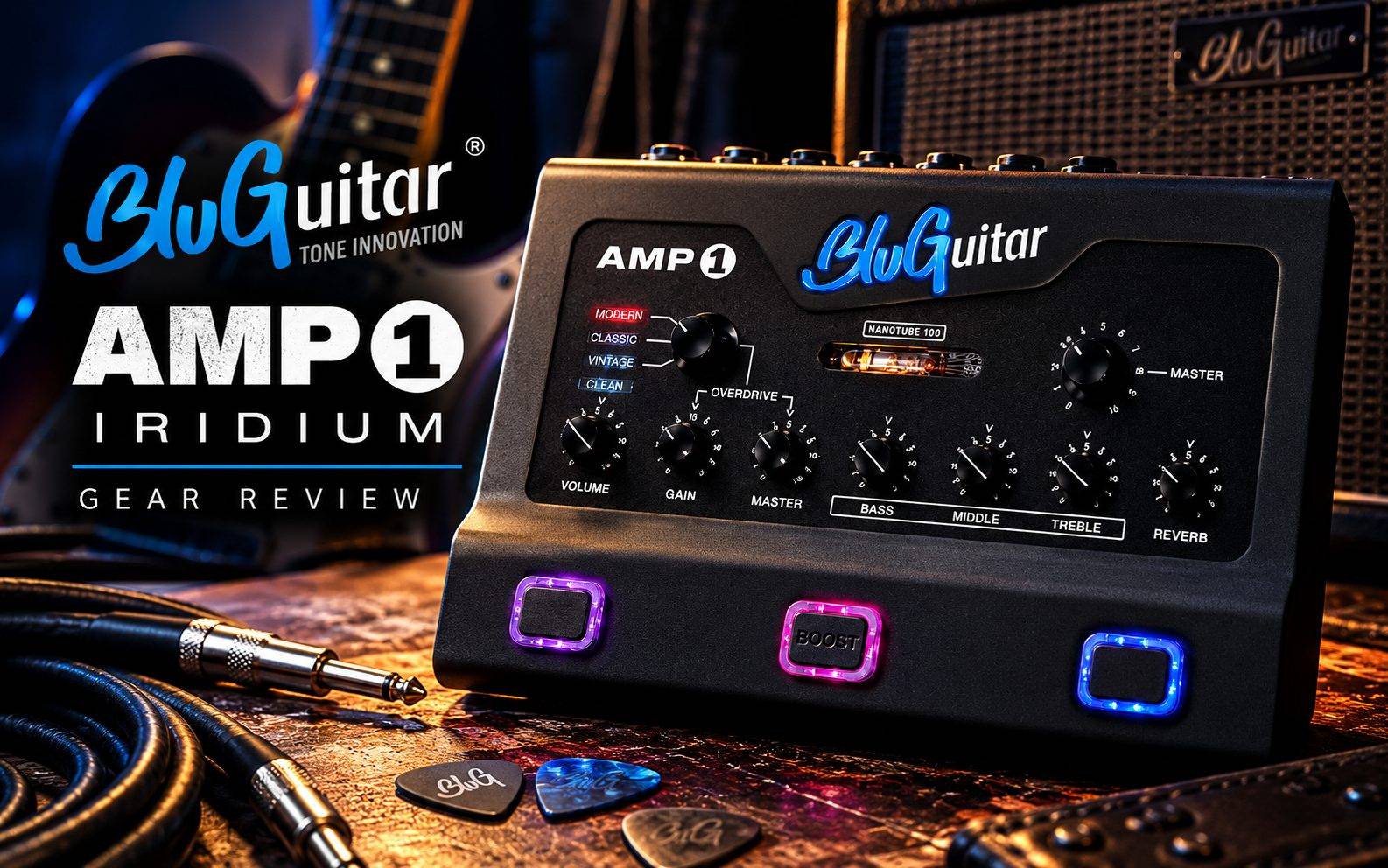
The holy grail of amplification has always been legendary tube tone in a portable, reliable package. The BluGuitar AMP1 Iridium offers a 100-watt tube feel in a lunchbox-sized unit, with cab-simulated XLR outputs, an effects loop, and boost functions that make it a recording interface, FOH solution, and pedalboard centerpiece in one.
What Exactly Is It?
A hybrid nano amplifier built on BluGuitar's Nanotube technology - a single 12AX7-style tube feeding a 100-watt RMS MOSFET power section, combining tube dynamics with solid-state reliability and weight.
The Four Channels of Fire
Clean (VOX-inspired) is sparkling and pedal-friendly. Crunch (Plexi-inspired) delivers gritty, harmonically rich overdrive. Lead 1 offers focused, singing lead tones, and Lead 2 brings aggressive modern high-gain. A Fat Switch adds warmth to Clean, and a global Boost lifts solos.
Feel and Versatility
It cleans up with rolled-back guitar volume and responds to picking dynamics like a great tube amp. Run it into a 4x12 on stage with XLR to the PA, record studio-quality tones at home with no mics, or make it the heart of a one-hand pedalboard rig.
The Verdict
The AMP1 Iridium isn't just gear; it's a solution. For its size, weight, and versatility, it stands toe-to-toe with amps ten times its size.